


bachelor’s degree in advanced artistic education in music
.
Academic Requirements for Access to Higher Artistic Music Education
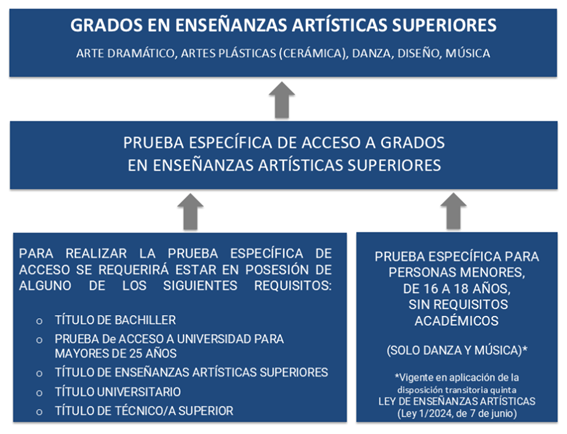
In accordance with Article 7 of Law 1/2024, of 7 June, which regulates artistic education
and establishes the organization and equivalences of professional artistic education,
«In order to access the bachelor’s degree in higher artistic education, the following requirements must be met:
a) To be in possession of a Baccalaureate degree, or a degree in higher artistic education, university degree or Higher Technician degree, or a degree declared equivalent or homologated to these degrees, or to have passed the university entrance exam for those over 25 years of age.
b) To have passed a specific entrance test to the corresponding discipline, in which it must be demonstrated that they possess the knowledge, abilities, skills and aptitudes necessary to take advantage of the teachings.»
Foreign students must present the homologation of the degree by the Ministerio de Educación, Formación Profesional y Deportes.
.
Specific Access Test
Structure and content of the Specific Entrance Test
- Part One:
Interpretation of a 30-minute program of at least three different styles. The applicant must interpret, at least, a work of memory. This test has an eliminatory character and represents, in case of passing it, 50 percent of the final grade.
- Part Two:
Structural and historical analysis of a musical fragment. It represents 25 percent of the final grade.
- Part Three:
Reading in sight with the main instrument of the itinerary to which it is chosen. It represents 25 percent of the final grade.
Structure of the Interpretation test:
Voice Double bass Clarinet Basoon Flute Guitar Oboe Percussion Piano
Saxophone Trombone Horn Trumpet Tuba Viola Violin Cello
- Part One:
It is eliminatory in nature and accounts for 60% of the final grade of the specific test. Applicants must obtain a grade equal to or greater than 5 out of 10 to be able to complete the second part.
1.A. Harmonic, structural and stylistic analysis of a piece or musical fragment proposed by the court. It will represent 30% of the final grade.
1.B. Writing exercise of harmonic, contrapuntal character or a combination of both types of writing. It will represent 30% of the final grade. - Part Two:
It has no eliminatory character and represents 40% of the final grade of the specific test.
2.A. Exercise of musical dictation or solphistic reading. It will represent 10% of the final grade.
2.B. Piano performance of a piece prepared by the applicant and/or reading at the piano. It will represent 10% of the final grade.
2.C. Interview about own works made by the applicant and defense of them, with a maximum of three works presented. It will represent 20% of the final grade
Structure of the Composition test
- First part. Of an eliminatory nature, it will represent in the seu conjunt and in case of being passed, 50% of the final grade of the test. Aspirants must obtain a qualification equal to or greater than 5 out of 10 in order to be able to carry out the second part.
-
- 1.A: Interpretació d’un fragment musical amb l’instrument propi. The candidate will present two works of different styles and the tribunal will decide the fragment and duration to be performed of these.
It will represent, in case of passing the first part, 5% of the final grade.
-
- 1.B: Piano reduction of a choral score. The tribunal may request the candidate to interpret two or more times. It will represent, in case of passing the first part, 5% of the final grade.
- 1.C: Auditory proba. It will represent, in case of passing the first part, 20% of the final grade. The tribunal will decide the contingut of this prova can include one or more of the exercicis according to the following: dictat d’1 a 4 veus, reconeixement de concordes, detecció d’errors en partitura i dictat rítmic.
- 1.D. Prova de solfeig. It will represent, in case of passing the first part, 20% of the final grade. The court will decide the contingut of this prova can include one or more of the following types of exercicis or the following combination: rhythmic exercise, intonation exercise, melodic-express exercise with the effects of the exhibition and transport exercise.
The candidate will carry out the exercicis to accompany the gestation.
- Segona part. It will not have an eliminatory character and will represent, in the seu conjunt, 50% of the final grade of the test.
-
- 2.A: Analysis of a different musical fragments proposed by the court. It will represent 15% of the final grade.
- 2.B: Harmony. Realització d’exercicis proposats pel tribunal. It will represent 15% of the final grade.
- 2.C: Prova d’adreça: To conduct a fragment of the Egmont Overture. Op. 84 L. van Beethoven. The school will provide a pianist who will interpret the work in reaction to the student’s gesture, but the student must conduct by giving the indications to an imaginary orchestra. The tribunal may ask the applicant any questions it considers opportune about the work to be directed, as well as propose to propose different alternative techniques for being carried out by the aspirant. It will represent 15% of the final grade.
- 2.D: Personal interview with the appraisal commission. It will represent 5% of the final grade.
Indicative repertoire for the exercise to be carried out with the own instrument
- Part One:
Of an eliminatory nature, it represents in case of being passed, a third of the final grade of the test. Applicants must obtain a grade equal to or greater than 5 out of 10 to be able to complete the second part.
– Exercise 1: Interpretation of a 30-minute program of at least three different styles. The applicant must interpret, at least, one work of memory. - Part Two:
It has no eliminatory character and represents two thirds of the final grade of the test.
– Exercise 2: Structural and historical analysis of a musical fragment. It represents one third of the final grade.
– Exercise 3: Sight reading on the piano, with prior preparation on a piano. It represents one third of the final grade.
Structure of the Pedagogy test
-
- Interpretation of a 15-minute program of at least three different styles. It represents 25% of the final grade.
- Structural and historical analysis of a musical fragment with score and audition. It represents 25% of the final grade.
- Exercise of harmonization to four voices of a bass and / or tiple. It represents 25% of the final grade.
- Commentary of a text of musical theme and questionnaire on it (historical, aesthetic, social and artistic aspects). It represents 25% of the final grade.
Structure of the Musicology test
In any of the above specialties, to obtain the final weighted grade it will be mandatory to perform all the exercises of the tests.
The average grade of the professional studies record, the submission of which is optional, constitutes 50% of the grade of the specific entrance exam, in the case of being in possession of the Professional Title of Music, as long as the weighted qualification of all the exercises carried out is a qualification equal to or greater than 5. It will only be taken into account if it improves the score on the Specific Admission Test and will in no way lower that score.
Analysis Test Example
Composition Test Examples
Example Musicology Test
Example reading to 1st view Voice
Example reading to 1st view Clarinet
Example reading to 1st view Bassoon
Example reading to 1st view Oboe
Example reading to 1st view Flute
Example reading to 1st view Percussion
Example reading to 1st view Piano
Example reading to 1st view Saxophone
Example reading at 1st view Horn
Example reading at 1st view Trombone
Example reading to 1st view Trumpet
Example reading to 1st view Tuba
Example reading at 1st view Pedagogy
Example solfistic test Conducting
Examples reading at 1st view Conducting
Ejemplo lectura a 1ª vista Violin
Ejemplo lectura a 1ª vista Viola
Ejemplo lectura a 1ª vista Cello
Ejemplo lectura a 1ª vista Double Bass
.
.
Access test Regulations
ÒSCAR ESPLÁ SUPERIOR MUSIC CONSERVATORY OF ALICANTE
C/ Catedrático Jaume Mas i Porcel, 2. 03005 Alicante (España).
Phone: 966 47 86 65
e-mail: 03010739@iseacv.gva.es
Contact us

Copyright (c) 2016 Copyright (c) 2016 Superior Conservatory of Music Óscar Esplá of Alicante. All rights reserved. | Legal notice