


Below, we’ll provide you with all the information you need regarding admission to undergraduate and master’s programs at CSMA
.
admission to the bachelor’s degree program in advanced music education
Academic Requirements for Access to Higher Artistic Music Education
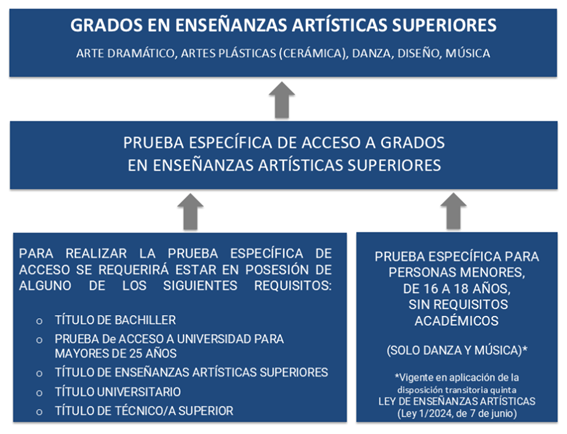
In accordance with Article 7 of Law 1/2024, of 7 June, which regulates artistic education
and establishes the organization and equivalences of professional artistic education,
«In order to access the bachelor’s degree in higher artistic education, the following requirements must be met:
a) To be in possession of a Baccalaureate degree, or a degree in higher artistic education, university degree or Higher Technician degree, or a degree declared equivalent or homologated to these degrees, or to have passed the university entrance exam for those over 25 years of age.
b) To have passed a specific entrance test to the corresponding discipline, in which it must be demonstrated that they possess the knowledge, abilities, skills and aptitudes necessary to take advantage of the teachings.»
Foreign students must present the homologation of the degree by the Ministerio de Educación, Formación Profesional y Deportes.
Specific Access Test
Structure and content of the Specific Entrance Test
In any of the above specialties, to obtain the final weighted grade it will be mandatory to perform all the exercises of the tests.
The average grade of the professional studies record, the submission of which is optional, constitutes 50% of the grade of the specific entrance exam, in the case of being in possession of the Professional Title of Music, as long as the weighted qualification of all the exercises carried out is a qualification equal to or greater than 5. It will only be taken into account if it improves the score on the Specific Admission Test and will in no way lower that score.
Analysis Test Example
Composition Test Examples
Example Musicology Test
Example reading to 1st view Voice
Example reading to 1st view Clarinet
Example reading to 1st view Bassoon
Example reading to 1st view Oboe
Example reading to 1st view Flute
Example reading to 1st view Percussion
Example reading to 1st view Piano
Example reading to 1st view Saxophone
Example reading at 1st view Horn
Example reading at 1st view Trombone
Example reading to 1st view Trumpet
Example reading to 1st view Tuba
Example reading at 1st view Pedagogy
Example solfistic test Conducting
Examples reading at 1st view Conducting
Ejemplo lectura a 1ª vista Violin
Ejemplo lectura a 1ª vista Viola
Ejemplo lectura a 1ª vista Cello
Ejemplo lectura a 1ª vista Double Bass
Access test Regulations
.
admission to the master’s degree of arts: performance and research in music
Academic requirements for access to the Master’s Degree in Artistic Education in Music Performance and Research
In order to gain access to the official Master’s degrees, it will be necessary to have an official Higher Degree of artistic education, an official Degree or Graduated Degree or its equivalent issued by an institution of the European Higher Education Area which authorizes in the country issuing the Title for access to Master’s teachings.
They will also be able to access the graduates according to educational systems outside the European Higher Education Area without the need for homologation of their degrees, after verification by the competent Educational Administration that those who accredit an equivalent level of education. Access in this way will not imply, in any case, the homologation of the previous degree that is in the possession of the interested party, or its recognition for other purposes than that of studying the master’s artistic teachings.
Applicants must complete the pre-registration form on the ARTIC platform.
Before taking the entrance exam, the candidate will have to pass an interview with the CAT, in which he will present his expectations about the master’s degreee, in addition to commenting on the questions that are asked of him regarding his musical career, curriculum vitae and other aspects. If the CAT considers it appropriate, it may include a written test in the interviews to assess the applicant’s general knowledge, consisting of a comment on a musical text and bibliographic citations.
Information and requirements for access to the official Studies of Master in Artistic Education
Master’s Degree in Artistic Education in Music Performance and Research Entrance Exams
Pre-registration for the 2026-2027 academic year:
This is done online through the following links:
-
- March 31 to April 27, 2026
- September 2026
It is advisable to register on ARTIC and pay the fees as soon as possible.
If you have problems paying the fees through ARTIC, you can make the payment through this link.
SELECTION INTERVIEWS AND ENTRANCE EXAMS:
First call:
-
- April 26 and 27.
- April 28, provisional results of those admitted to the entrance exams. (Posted at 9:00 a.m.). Deadline for appealing the provisional list of admitted applicants for the entrance exams: 48 hours after publication.
- April 30, final results of those admitted to the entrance exams.
- April 30, Call for interviews. Selection interviews and entrance exams will be held on May 4 and 5 as specified in the following document: Structure and Content of the Entrance Exams..
- May 11, Provisional results for admission to the Master’s program. Deadline for appealing the provisional results for admission to the Master’s program: 48 hours after publication. Request for review of the entrance exam score for the Master’s program.
- May 20: Final results for admission to the Master’s program.
- June 30: Publication of the final results for admission to the Master’s program.
Second call:
-
-
- September: Publication pending.
- September: Publication of provisional results for admission to the entrance exams. Publication pending. Publication pending. Deadline for appeals against the provisional list of admitted candidates for the entrance exams: 48 hours after publication.
- September: Publication of final results for admission to the entrance exams.
- September: Call for interviews. The selection interviews and entrance exams will be held in September as specified in the following document: Structure and Content of the Entrance Exams..
-
REQUIRED DOCUMENTATION
-
Proof of payment of fees
- Passport-size photography
- Photocopy of ID. Foreign students will present a photocopy of the passport and NIE
- Bachelor’s degree or equivalent. International students must submit the recognition of the degree by the Ministry of Education. If you are still waiting to receive your bachelor’s degree, you must submit the completed Form for Provisional Enrollment in Educational Institutions or Official Exams, the application for recognition, along with payment of the applicable fees and a copy of your academic transcript.
- Curriculum vitae que incluya copia de los méritos aportados.
- Curriculum vitae that includes copy of the merits provided.
- YouTube link to the video recording.
All documentation will be sent to the Center’s Secretariat through the following FORM
If you have any questions, please feel free to contact us by email at: master@csmalicante.com
Master’s Degree in Artistic Education in Music Performance and Research Regulations